
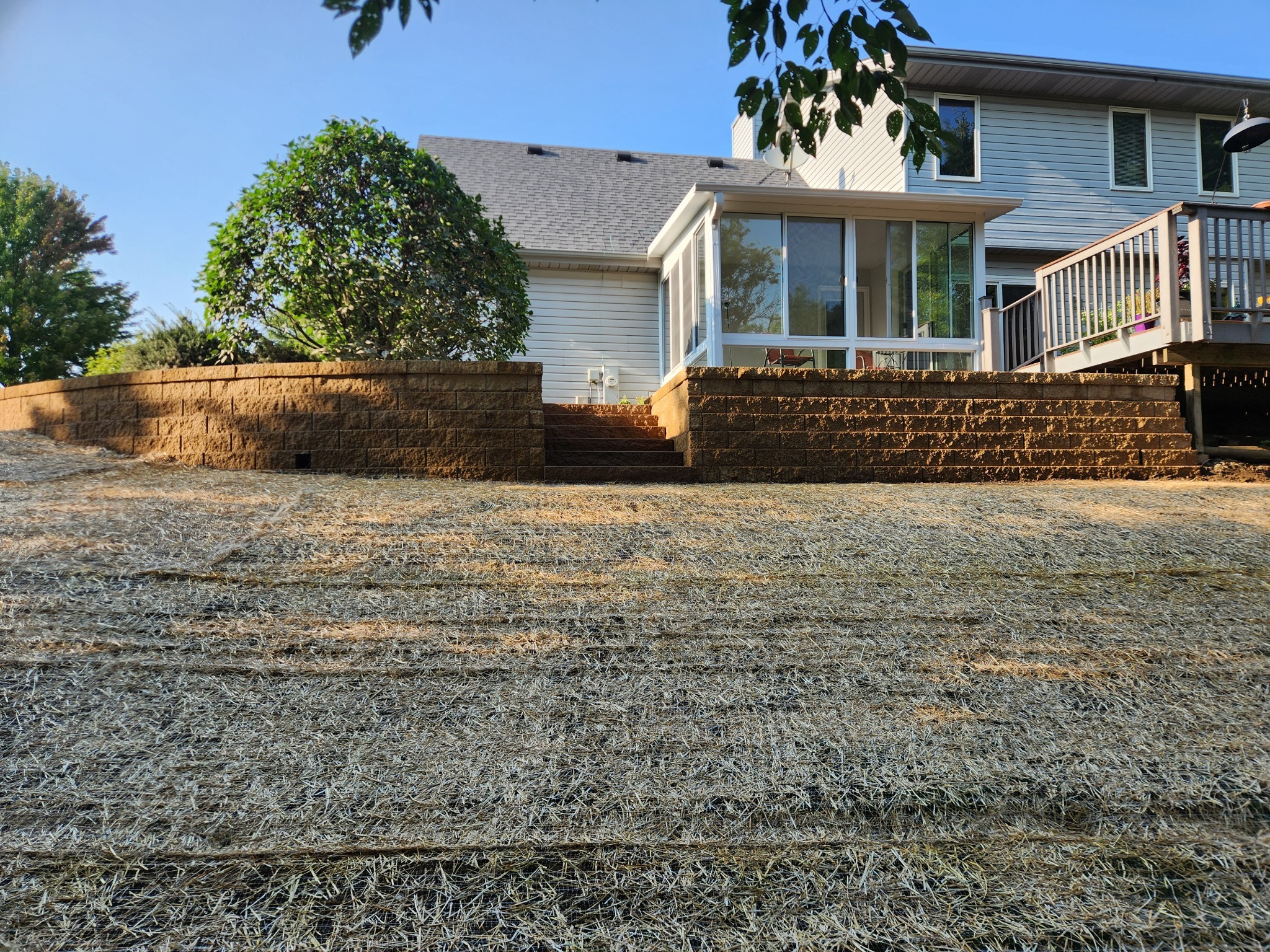
Worried about a slope that keeps creeping downhill after storms or spring thaw? A boulder retaining wall can stabilize a sliding hill when it is designed and built the right way. In this guide, you will learn how these walls work, when they are the best solution, what they cost, and how to get a long lasting result on your property. Koch Kuts has over 25 years of experience building retaining walls in Southeast Wisconsin, and we are here to help you choose the safest and most cost effective plan for your landscape.
Why Do Hills Slide in the First Place?
Understanding the cause of movement is the first step to stopping it. Hills move for several reasons, and it is common for more than one factor to be at play.
- Water pressure builds up in soil after rain or snowmelt, which reduces friction and makes soil lose strength.
- Poor drainage or clogged downspouts concentrate water in one area and create a slip surface.
- Freeze and thaw cycles expand soil in winter, then soften it in spring, which can nudge slopes outward.
- Fill dirt from past projects may not be compacted well, so it settles and slides.
- Steep slopes, lack of groundcover, and bare clay surfaces make it easy for gravity to win.
A retaining wall resists lateral soil pressure and helps manage water, both of which are key to halting movement. When sized and drained correctly, a wall can create a stable, usable area where the slope once moved.
What Is a Boulder Retaining Wall?
A boulder retaining wall is built from large natural stones placed in stepped courses to hold back soil. The stones are heavy, interlock well, and drain naturally through joints. In Wisconsin, boulders often come from glacial fieldstone or local quarries, which means they blend well with native landscapes. Unlike wood or some segmental blocks, boulders are thick and massive, so they resist bulging and handle freeze cycles with less risk of cracking.
Can a Boulder Retaining Wall Stop a Sliding Hill?
Yes, a boulder retaining wall can stop a sliding hill when the design matches the site conditions. The wall must be tall and wide enough to resist pressure, sit on a compacted stone base, and include proper drainage. In many cases, adding geogrid reinforcement, terraced tiers, or improved surface grading will be needed to fully stabilize the slope. In extreme landslides or on very tall slopes, you may also need an engineer to design the wall and soil reinforcement plan. Koch Kuts regularly partners with engineers on complex jobs to make sure every wall performs as intended.
When a Boulder Retaining Wall Is the Right Choice
- The slope moves after heavy rain and you need better drainage and mass to resist push.
- You want a natural look that complements plantings, patios, and shoreline features.
- The wall height is generally under 6 to 8 feet per tier, or you agree to use geogrid and engineering for taller sections.
- There is equipment access for safe and efficient placement of large stones.
- You want a durable, low maintenance wall that stands up to Wisconsin winters.
When a Single Wall May Not Be Enough
- The slope is very tall or extremely steep. Terracing into multiple shorter walls often performs better.
- Water is trapped behind the slope by bedrock or a perched water table. Extra drainage measures may be required.
- There is evidence of deep, ongoing landslide movement that extends beyond the topsoil. Engineering is a must.
- Structures are close to the slope crest. You will need a higher safety factor and possibly soil reinforcement.
Pros and Cons of a Boulder Retaining Wall
Advantages
- Natural beauty that fits residential and commercial landscapes.
- High mass and friction that resist soil pressure and minor impacts.
- Excellent drainage through stone joints when paired with proper backfill.
- Durability in freeze and thaw cycles with little risk of cracking.
- Flexible layout for curves and naturalized terraces.
Potential Drawbacks
- Requires equipment access and skilled installation.
- Heavier footprint than thin modular blocks, which needs space.
- May need geogrid or engineering for taller walls.
- Stone selection matters. Poorly shaped or undersized boulders reduce stability.
What Does a Boulder Retaining Wall Cost in Southeast Wisconsin?
Costs vary with site access, wall height, stone type, drainage needs, and reinforcement. As a general guide, many boulder retaining walls in our area range from about 45 to 125 dollars per square face foot. Smaller garden walls can fall below that range, while engineered or hard to access sites can be higher. Here is a simple way to estimate. Measure the length and average height of the wall. Multiply length by height to get square face feet. Then multiply by a rough cost per square foot to create a budget range. Example. A wall 50 feet long and 4 feet high has 200 square face feet. At 65 to 100 dollars per square foot, the budget would be 13,000 to 20,000 dollars. Site specific conditions can change costs, but this gives a useful ballpark. Koch Kuts offers clear, written estimates so you know exactly what is included. We also provide options to value engineer your project without sacrificing safety.
Do You Need Permits or Engineering?
Many communities require permits for walls over a certain height, usually around 3 to 4 feet, or when walls are near property lines or water. Commercial projects often need stamped engineering. If your slope shows major movement, is near a building, or the wall will be tall, engineering is a wise investment. Koch Kuts helps clients in Burlington, Waterford, Mukwonago, Lake Geneva, Racine, and nearby communities navigate permits and coordinate with engineers. We also call in utility locates to protect underground lines before digging.
How Koch Kuts Builds a Boulder Retaining Wall That Lasts
- Site evaluation. We inspect the slope, soil type, drainage patterns, and structures nearby. We look for evidence of movement and water sources such as downspouts or springs.
- Design and layout. We set wall height, line, and grade. For tall walls, we bring in geogrid specifications and engineering when required.
- Excavation. We dig to create a level, undisturbed base area. We remove soft or organic soil until we reach solid subgrade.
- Base preparation. We install a compacted layer of angular crushed stone to form a stable, free draining base.
- First course placement. We set the largest boulders as the base course, level and keyed into the slope for bearing strength.
- Drainage system. We place perforated drain pipe at the back of the base, wrap in filter fabric as needed, and day light it to a safe outlet.
- Backfill and stacking. We backfill with clean, washed stone behind the wall for drainage. We step boulders back into the slope and interlock joints for stability.
- Reinforcement. For taller sections, we install geogrid at specified elevations, tying the wall face to compacted reinforced soil.
- Surface grading. We shape the grade at the top of the wall to shed water away, extend downspouts, and add swales as needed.
- Finishing touches. We integrate plantings, erosion control blankets, or turf to protect bare soil and complete the look.
This process focuses on structure first, then appearance. The result is a wall that looks natural and holds strong through storm seasons and winters.
Drainage Is Everything
Without proper drainage, even a massive wall can fail. Good drainage reduces water pressure and protects the base from frost movement. Key elements include:
- Free draining gravel backfill instead of clay or topsoil directly behind the wall.
- Perforated drain pipe along the base that exits to a safe area.
- Filter fabric to keep fine soil from clogging gravel and pipe.
- Surface grading that sends water away from the slope and wall.
- Downspout extensions that do not dump water behind the wall.
Alternatives and Add Ons for Tough Slopes
- Terraces. Build two or three shorter walls with planted shelves to reduce pressure and improve aesthetics.
- Geogrid reinforced slopes. Combine a lower boulder retaining wall with reinforced soil above.
- Drainage upgrades. Add swales, French drains, or catch basins to move water off the slope.
- Vegetation and erosion control. Deep rooted native plants, erosion blankets, and mulch protect soil and slow runoff.
- Riprap or shoreline restoration. On lakefront or stream banks, stone armoring and planting work with a wall to stop erosion.
Common Mistakes to Avoid
- Skipping the base stone or placing the wall on topsoil. This invites settling and tipping.
- Backfilling with clay. Clay traps water and builds pressure.
- No outlet for the drain pipe. A dead end drain will not protect your wall.
- Making the wall too vertical. Boulder walls need a slight batter, or step back, for strength.
- Using stones that are too small. Mix of large base boulders and well locked courses is crucial.
- Forgetting to manage surface water. Downspouts and yard grading must be part of the plan.
Maintenance Tips for Long Life
- Inspect after major storms to confirm water is flowing out of drain outlets.
- Keep drain outlets and swales clear of debris and leaves.
- Touch up joint soils or plantings on terraces to prevent erosion.
- Watch for settling near the top of the wall and contact a professional if you see movement.
- Redirect sprinklers so they do not saturate the slope behind the wall.
Frequently Asked Questions
How tall can a boulder retaining wall be?
With proper design, boulder walls can reach significant heights, but once you go above about 4 feet in many municipalities, permits are required and geogrid or engineering may be needed. Taller walls often perform better when split into terraces. Koch Kuts will help you pick the safest approach for your property and code requirements.
Do I need an engineer for my wall?
If the wall is tall, supports a driveway or structure, is near a property line, or is part of a slope that has a history of movement, engineering is advised. For simple, low garden walls, it may not be necessary. Our team can coordinate engineering when appropriate.
Will a boulder retaining wall work in clay soil?
Yes, if the design addresses drainage. Clean stone backfill, a reliable drain pipe, and correct grading are essential. In clay, water management is even more important than in sandy soils.
Can I build a wall in winter?
It is possible during milder winter periods if the base can be excavated to unfrozen subgrade and stone can be compacted. Many projects are best scheduled for spring through fall for efficiency. Koch Kuts will advise on timing for your site.
How long will a boulder retaining wall last?
With proper base preparation and drainage, a boulder retaining wall can last for decades with minimal maintenance. Natural stone does not rot, and the flexible, dry stacked design performs well through freeze and thaw cycles.
Why Choose Koch Kuts for Your Boulder Retaining Wall
Koch Kuts is a full service landscaping and hardscaping company based in Burlington, Wisconsin. For more than 25 years, homeowners and businesses across Southeast Wisconsin have trusted us to stabilize slopes, create outdoor living spaces, and add curb appeal. Our team designs and builds paver patios, retaining walls, outdoor fireplaces, pool hardscapes, shoreline restoration, and more. We also handle land preparation, excavation, grading, premium driveways, and fence line clearing. If your hill is sliding, we bring the right blend of experience, equipment, and care to fix it the right way.
We serve Burlington, Waterford, Mukwonago, Lake Geneva, Racine, and surrounding communities. From the first site visit to the final cleanup, you will get clear communication, dependable scheduling, and quality workmanship. Our goal is to build a wall that looks great on day one and still performs years down the road.
How to Get Started
- Schedule a site visit. We assess your slope, drainage, and goals.
- Receive a detailed plan and estimate tailored to your property.
- Approve the design. We handle permits and utility locates as needed.
- Build with confidence. Our crew installs your boulder retaining wall with care and precision.
- Enjoy a stable, attractive landscape with less erosion and more usable space.
If you are asking whether a retaining wall can stop your sliding hill, the answer is yes when design, drainage, and construction are done right. Contact Koch Kuts to request a free estimate and get expert advice for your property. Visit kochkuts.com to learn more and see how our team can turn a problem slope into a safe and beautiful space.


